
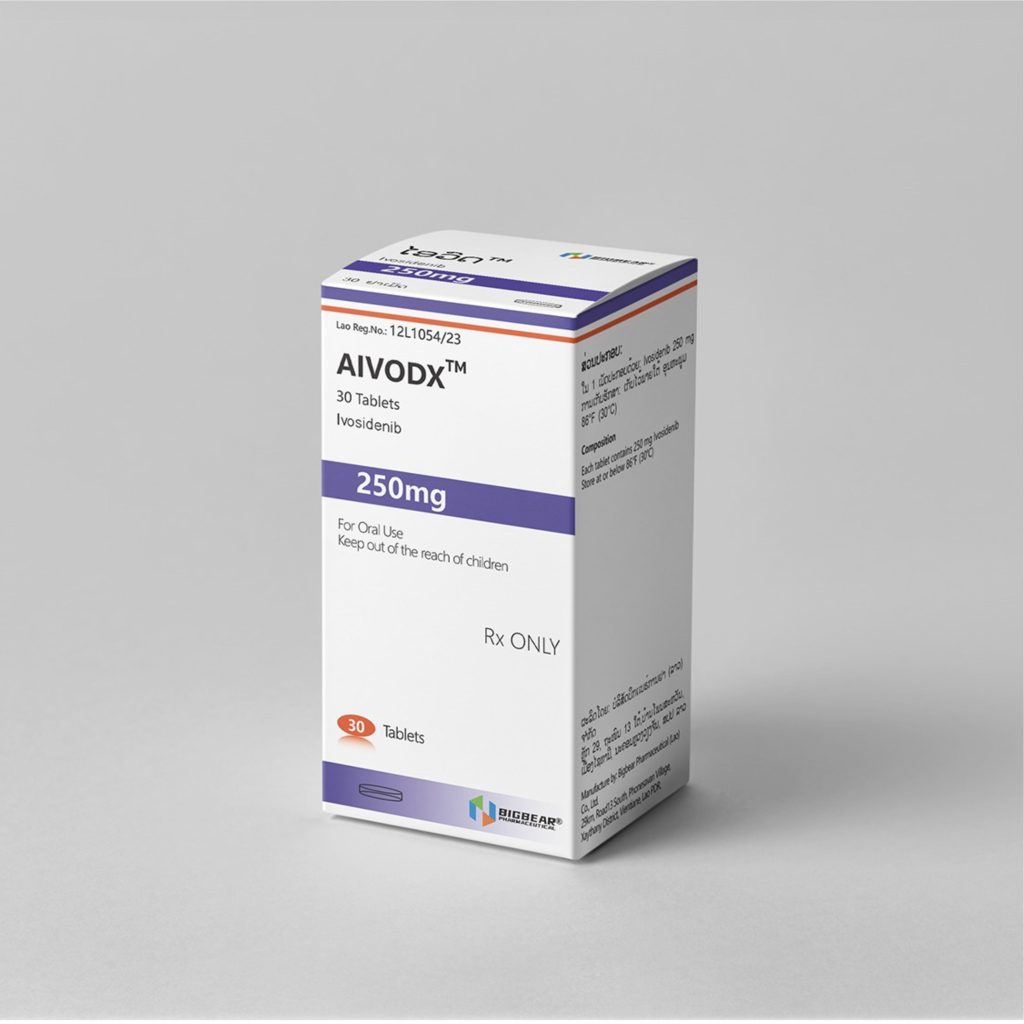
AIVODX (Ivosidenib Tablets 250mg)
Product Overview
AIVODX contains ivosidenib, an oral, targeted inhibitor of mutant isocitrate dehydrogenase-1 (IDH1).
Ivosidenib is developed for the treatment of certain malignancies harboring susceptible IDH1 mutations, including specific forms of acute myeloid leukemia (AML), myelodysplastic syndromes (MDS), and cholangiocarcinoma.
Mutant IDH1 produces abnormal levels of the oncometabolite 2-hydroxyglutarate (2-HG), which can interfere with normal cellular differentiation.
By inhibiting mutant IDH1 activity, ivosidenib reduces 2-HG production and may help restore cellular differentiation in susceptible cancer cells.
AIVODX is presented as 250mg oral tablets, with 30 tablets per box, under the BIGBEAR pharmaceutical brand in Laos.
Therapeutic Indications
The following indications are based on the U.S. FDA-approved reference product TIBSOVO (ivosidenib).
1. Newly Diagnosed Acute Myeloid Leukemia (AML)
Ivosidenib is indicated, in combination with azacitidine or as monotherapy, for adults with newly diagnosed AML harboring a susceptible IDH1 mutation who:
- Are 75 years of age or older; or
- Have comorbidities that preclude the use of intensive induction chemotherapy.
IDH1 mutation status must be confirmed using an appropriate approved diagnostic test.
2. Relapsed or Refractory Acute Myeloid Leukemia (AML)
Ivosidenib is indicated for adult patients with relapsed or refractory AML harboring a susceptible IDH1 mutation, as identified by an approved diagnostic test.
3. Relapsed or Refractory Myelodysplastic Syndromes (MDS)
Ivosidenib is indicated for adult patients with relapsed or refractory myelodysplastic syndromes harboring a susceptible IDH1 mutation.
This indication was approved by the U.S. FDA in October 2023.
4. Locally Advanced or Metastatic Cholangiocarcinoma
Ivosidenib is indicated for adult patients with previously treated locally advanced or metastatic cholangiocarcinoma harboring a susceptible IDH1 mutation.
Cholangiocarcinoma is a malignancy originating from the bile duct epithelium.
Ivosidenib provides a molecularly targeted treatment option for eligible patients whose tumors have a susceptible IDH1 mutation.
Regulatory Note: These indications are based on the U.S. reference prescribing information for TIBSOVO. The locally approved indications and regulatory status of AIVODX in Laos must be independently verified.
Mechanism of Action
Ivosidenib is a selective inhibitor of mutant isocitrate dehydrogenase-1 (IDH1).
Mutations in IDH1 can lead to abnormal production of 2-hydroxyglutarate (2-HG), an oncometabolite associated with impaired cellular differentiation and malignant transformation.
Ivosidenib inhibits susceptible mutant IDH1 enzymes and reduces the production of 2-HG.
This activity may promote cellular differentiation and inhibit malignant processes in tumors driven by susceptible IDH1 mutations.
Its therapeutic activity depends on the presence of an appropriate molecular alteration and the clinical treatment setting.
Molecular Target: Mutant IDH1 (Isocitrate Dehydrogenase-1)
Drug Classification: Mutant IDH1 Inhibitor / Targeted Antineoplastic Agent
Product Information
- Generic Name: Ivosidenib
- Brand Name: AIVODX
- Strength: 250mg
- Pack Size: 30 Tablets per Box
- Dosage Form: Oral Tablets
- Manufacturer: BIGBEAR Pharmaceutical
- Country of Manufacture: Laos
- Lao Registration Number (as printed): 12L1054/23
- Prescription Status: Rx Only
Dosage and Administration
According to the U.S. reference prescribing information for TIBSOVO, the recommended dosage of ivosidenib for approved indications is 500mg orally once daily, subject to the applicable treatment regimen and individual clinical considerations.
Treatment may be administered as monotherapy or in combination with azacitidine for specified AML patients.
Tablets may be taken with or without food. Administration with a high-fat meal should be avoided.
Tablets should be swallowed whole and should not be split, crushed, or chewed.
The dosage may require modification due to adverse reactions, concomitant medications, QT interval prolongation, or other clinical factors.
Patients require appropriate laboratory assessment, electrocardiographic monitoring, and clinical supervision.
Packaging Note: AIVODX contains 30 tablets of 250mg each per box. At the historical reference dosage of 500mg once daily, one box contains 15 days of medication, not a full 30-day supply.
Regulatory Note: These are reference-product dosing instructions and do not constitute an independent dosing recommendation for AIVODX. The locally approved prescribing information must be followed.
Warnings and Precautions
1. Differentiation Syndrome
Ivosidenib may cause differentiation syndrome in patients with AML or MDS.
This serious and potentially fatal complication may involve:
- Fever
- Difficulty breathing
- Hypoxia
- Pulmonary infiltrates
- Pleural or pericardial effusions
- Rapid weight gain
- Peripheral edema
- Low blood pressure
- Renal or hepatic dysfunction
Suspected differentiation syndrome requires urgent medical assessment and treatment.
2. QTc Interval Prolongation
Ivosidenib may prolong the QTc interval and increase the risk of serious cardiac arrhythmias.
Electrocardiograms and electrolyte levels should be monitored before and during treatment.
Caution is required with medicines that may prolong the QT interval.
3. Guillain-Barré Syndrome
Guillain-Barré syndrome, a potentially serious neurologic condition, has been reported in patients receiving ivosidenib.
New or progressive muscle weakness, sensory disturbances, or other neurologic symptoms require prompt medical evaluation.
4. Hepatic and Renal Abnormalities
Abnormal liver function tests and changes in renal function may occur.
Appropriate laboratory monitoring is required during treatment.
5. Hematologic Abnormalities
Changes in blood cell counts, including anemia, thrombocytopenia, and leukocytosis, may occur depending on the underlying disease and treatment regimen.
Complete blood counts should be monitored as clinically indicated.
6. Drug Interactions
Ivosidenib is metabolized primarily through CYP3A4 pathways.
Strong CYP3A4 inhibitors may increase exposure to ivosidenib and the risk of QTc prolongation.
Strong CYP3A4 inducers may reduce drug exposure.
Ivosidenib can also affect the exposure of certain concomitant medicines.
Medicines that prolong the QT interval should generally be avoided unless clinically necessary and appropriately monitored.
7. Embryo-Fetal Toxicity
Ivosidenib may cause fetal harm when administered during pregnancy.
Appropriate reproductive counseling and contraception precautions are required.
Adverse Reactions
Adverse reactions reported with ivosidenib vary according to the underlying malignancy and whether treatment is administered alone or in combination with other medicines.
Common adverse reactions may include:
- Fatigue
- Nausea
- Diarrhea
- Constipation
- Decreased appetite
- Abdominal pain
- Vomiting
- Peripheral edema
- Arthralgia
- Rash
- Cough
- Dyspnea
Laboratory abnormalities may include:
- Increased AST
- Increased ALT
- Anemia
- Thrombocytopenia
- Electrolyte abnormalities
- Changes in blood glucose levels
Serious adverse reactions may include differentiation syndrome, QTc prolongation, cardiac arrhythmias, and Guillain-Barré syndrome.
The incidence and severity of adverse reactions may differ across AML, MDS, and cholangiocarcinoma treatment populations.
Storage and Handling
According to the supplied AIVODX packaging, store at or below 30°C (86°F).
Keep the medicine in its original packaging.
Protect from moisture and unsuitable storage conditions.
Keep out of reach of children.
Do not use after the expiration date printed on the packaging.
Product-specific storage and handling requirements should be confirmed against the manufacturer’s approved documentation.
Medical Disclaimer
AIVODX is identified on the supplied packaging as a prescription-only pharmaceutical product containing ivosidenib.
This information is intended for professional pharmaceutical reference and product identification purposes only.
The therapeutic indications, dosage information, and safety precautions described above are based on publicly available reference prescribing information for ivosidenib.
They do not establish that AIVODX has received equivalent regulatory approvals in Laos or any other country.
The approved indications, dosage, safety requirements, and regulatory status of AIVODX must be confirmed against applicable local product documentation.
This information does not replace approved prescribing information, medical advice, diagnosis, or treatment.
International pharmaceutical supply is subject to applicable product registration, import authorization, prescription, and distribution requirements in the destination country.