
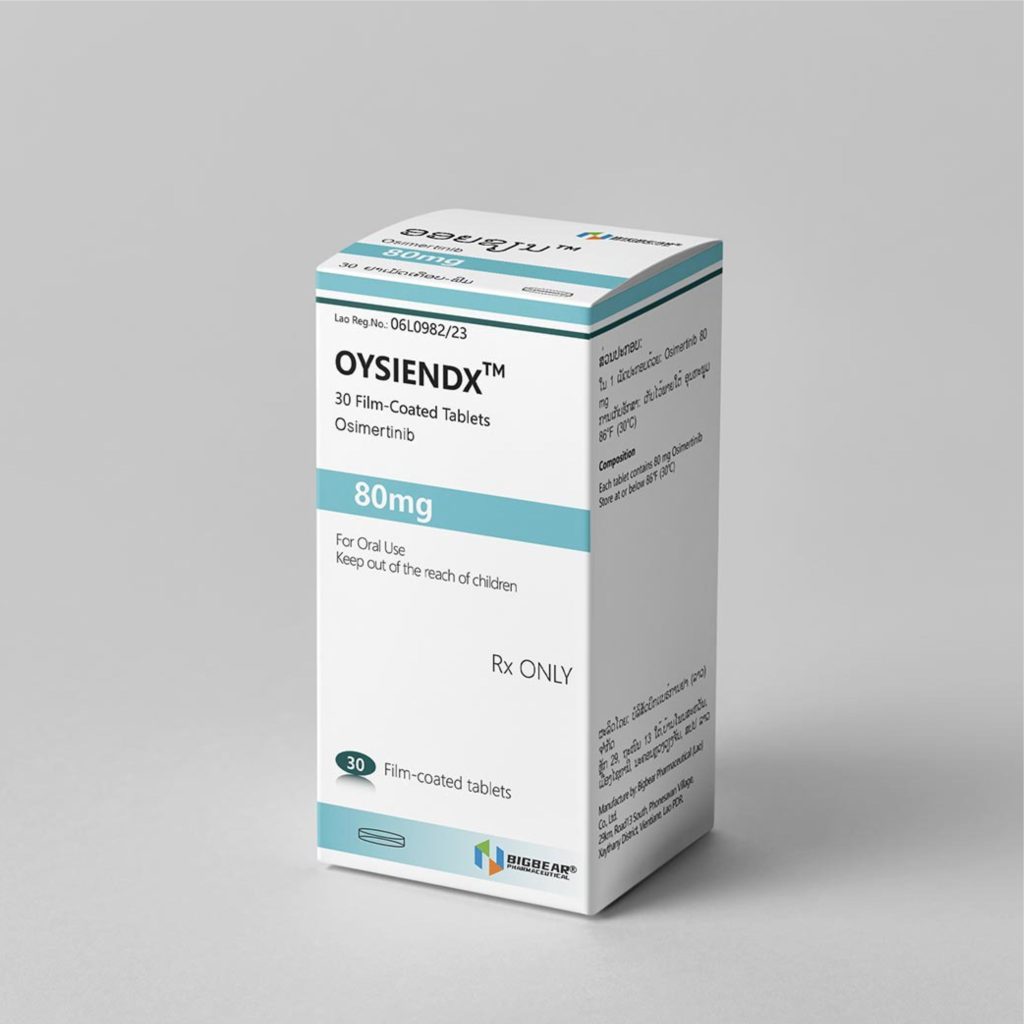
OYSIENDX (Osimertinib Film-Coated Tablets 80mg)
Product Overview
OYSIENDX contains osimertinib, an oral third-generation epidermal growth factor receptor (EGFR) tyrosine kinase inhibitor developed for the treatment of certain types of non-small cell lung cancer (NSCLC).
Osimertinib selectively inhibits EGFR signaling associated with specific activating mutations, including EGFR exon 19 deletions, exon 21 L858R mutations, and the T790M resistance mutation.
By inhibiting abnormal EGFR signaling, osimertinib helps suppress pathways involved in the growth and survival of susceptible cancer cells.
OYSIENDX is presented as 80mg film-coated tablets, with 30 tablets per box, under the BIGBEAR pharmaceutical brand in Laos.
Therapeutic Indications
The following indications are based on the U.S. FDA-approved reference product TAGRISSO (osimertinib).
1. Adjuvant Treatment of EGFR Mutation-Positive Non-Small Cell Lung Cancer
Osimertinib is indicated as adjuvant treatment after tumor resection in adult patients with NSCLC whose tumors harbor:
- EGFR exon 19 deletions; or
- EGFR exon 21 L858R mutations.
The relevant mutation must be identified using an FDA-approved diagnostic test.
2. Locally Advanced, Unresectable Stage III NSCLC
Osimertinib is indicated for adult patients with locally advanced, unresectable stage III NSCLC whose disease has not progressed during or following concurrent or sequential platinum-based chemoradiation therapy.
Eligible tumors must harbor EGFR exon 19 deletions or exon 21 L858R mutations, as identified by an FDA-approved test.
3. First-Line Treatment of Metastatic NSCLC
Osimertinib is indicated as first-line treatment for adult patients with metastatic NSCLC whose tumors harbor EGFR exon 19 deletions or exon 21 L858R mutations.
4. First-Line Combination Treatment
Osimertinib in combination with pemetrexed and platinum-based chemotherapy is indicated as first-line treatment for adult patients with locally advanced or metastatic NSCLC harboring EGFR exon 19 deletions or exon 21 L858R mutations.
The combination regimen requires appropriate oncology supervision and monitoring.
5. Previously Treated EGFR T790M Mutation-Positive Metastatic NSCLC
Osimertinib is indicated for adult patients with metastatic NSCLC harboring an EGFR T790M mutation whose disease has progressed during or after EGFR tyrosine kinase inhibitor therapy.
EGFR T790M mutation status must be confirmed using an appropriate approved diagnostic test.
Regulatory Note: These indications are based on the U.S. FDA-approved reference product TAGRISSO. The locally approved indications and regulatory status of OYSIENDX in Laos must be independently verified.
Mechanism of Action
Osimertinib is a third-generation, irreversible EGFR tyrosine kinase inhibitor.
It targets specific activating EGFR mutations, including exon 19 deletions and exon 21 L858R, as well as the EGFR T790M resistance mutation.
Osimertinib binds covalently to the kinase domain of mutant EGFR, inhibiting receptor phosphorylation and downstream signaling pathways.
This activity interferes with cellular signaling associated with tumor proliferation and survival.
Osimertinib also has activity against certain HER2-related signaling processes.
Molecular Target: EGFR (Exon 19 Deletion / Exon 21 L858R / T790M)
Drug Classification: Third-Generation EGFR Tyrosine Kinase Inhibitor (TKI)
Product Information
- Generic Name: Osimertinib
- Brand Name: OYSIENDX
- Strength: 80mg
- Pack Size: 30 Tablets per Box
- Dosage Form: Film-Coated Tablets
- Manufacturer: BIGBEAR Pharmaceutical
- Country of Manufacture: Laos
- Lao Registration Number (as printed): 06L0982/23
- Prescription Status: Rx Only
Dosage and Administration
According to the U.S. reference prescribing information for TAGRISSO, the recommended dosage of osimertinib for its approved indications is 80mg orally once daily, with or without food.
The duration of treatment depends on the indication:
Adjuvant Treatment
Treatment may continue for up to three years or until disease recurrence or unacceptable toxicity.
Locally Advanced, Unresectable Stage III NSCLC
Treatment may continue until disease progression or unacceptable toxicity.
Metastatic NSCLC
Treatment generally continues until disease progression or unacceptable toxicity.
Combination Treatment
Osimertinib may be administered with pemetrexed and platinum-based chemotherapy according to the approved combination regimen.
Dosage interruption, reduction, or discontinuation may be required depending on adverse reactions or other clinical considerations.
The reference product provides specific instructions for dispersing tablets in water for patients who have difficulty swallowing. Such administration instructions must not be assumed applicable to OYSIENDX without manufacturer confirmation.
Packaging Note: OYSIENDX contains 30 tablets of 80mg each per box. At the reference dosage of 80mg once daily, one box corresponds to 30 days of medication.
Regulatory Note: These are reference-product dosing instructions and do not replace the locally approved prescribing information for OYSIENDX.
Treatment must be prescribed and supervised by qualified healthcare professionals.
Warnings and Precautions
1. Interstitial Lung Disease (ILD) / Pneumonitis
Osimertinib may cause severe or fatal interstitial lung disease or pneumonitis.
Symptoms may include:
- New or worsening cough
- Shortness of breath
- Fever
- Difficulty breathing
Patients with suspected ILD or pneumonitis require prompt medical evaluation.
2. QTc Interval Prolongation
Osimertinib may prolong the QTc interval and increase the risk of serious cardiac arrhythmias.
Electrocardiogram and electrolyte monitoring may be required, especially in patients with additional cardiac risk factors.
3. Cardiomyopathy
Osimertinib may cause cardiomyopathy, including reduced left ventricular ejection fraction and heart failure.
Cardiac function should be assessed and monitored according to the treatment regimen and patient risk factors.
4. Keratitis
Keratitis and other ocular adverse reactions may occur.
Patients experiencing eye pain, redness, blurred vision, or other visual symptoms should receive appropriate ophthalmologic evaluation.
5. Severe Cutaneous Adverse Reactions
Serious skin reactions, including erythema multiforme major, Stevens-Johnson syndrome, and toxic epidermal necrolysis, have been reported.
Suspected severe skin reactions require immediate medical assessment.
6. Cutaneous Vasculitis
Cutaneous vasculitis has been reported in patients receiving osimertinib.
Clinical assessment and treatment modification may be required depending on severity.
7. Aplastic Anemia
Rare but potentially fatal cases of aplastic anemia have been reported.
Complete blood counts should be assessed before treatment and monitored during therapy.
8. Myalgia or Myositis with Creatine Phosphokinase Elevation
Muscle pain, myositis, and increased creatine phosphokinase (CPK) levels have been reported.
Rhabdomyolysis has also been identified in postmarketing reports.
Patients experiencing unexplained muscle pain, weakness, or tenderness require appropriate evaluation.
CPK monitoring may be necessary during treatment.
9. Embryo-Fetal Toxicity
Osimertinib may cause fetal harm when administered during pregnancy.
Appropriate contraception and reproductive risk counseling are required.
10. Drug Interactions
Strong CYP3A inducers may reduce osimertinib exposure.
Concomitant use with medicines that prolong the QT interval may increase the risk of cardiac adverse reactions.
Osimertinib may also affect exposure to certain medicines transported by BCRP or P-glycoprotein.
Patients should inform their healthcare providers about all prescription medicines, over-the-counter medicines, and supplements they use.
Adverse Reactions
Common adverse reactions associated with osimertinib treatment may include:
- Diarrhea
- Skin rash
- Dry skin
- Paronychia
- Stomatitis
- Fatigue
- Musculoskeletal pain
- Cough
- Decreased appetite
- Nausea
Laboratory abnormalities may include:
- Decreased white blood cell counts
- Decreased lymphocyte counts
- Decreased platelet counts
- Anemia
- Decreased neutrophil counts
Additional adverse reactions may occur when osimertinib is administered with pemetrexed and platinum-based chemotherapy.
Serious adverse reactions may include:
- Interstitial lung disease or pneumonitis
- QTc prolongation
- Cardiomyopathy
- Severe skin reactions
- Aplastic anemia
- Myositis or rhabdomyolysis
The frequency and severity of adverse reactions may vary according to treatment regimen, disease characteristics, and individual patient factors.
Storage and Handling
According to the supplied OYSIENDX packaging, store at or below 30°C (86°F).
Keep the medicine in its original packaging.
Protect from moisture, excessive heat, and unsuitable storage conditions.
Keep out of reach of children.
Do not use after the expiration date printed on the packaging.
Product-specific storage and handling requirements should be confirmed against the manufacturer’s approved documentation.
Medical Disclaimer
OYSIENDX is identified on the supplied packaging as a prescription-only pharmaceutical product containing osimertinib.
The information provided is intended for professional pharmaceutical reference and product identification purposes only.
The therapeutic indications, dosage information, and safety precautions described above are based on publicly available reference prescribing information for osimertinib.
They do not establish that OYSIENDX has received equivalent regulatory approvals in Laos or any other country.
The approved indications, dosage, safety warnings, and regulatory status of OYSIENDX must be confirmed against applicable local product documentation.
This information does not replace approved prescribing information, medical advice, diagnosis, or treatment.
International pharmaceutical supply is subject to applicable product registration, import authorization, prescription, and distribution requirements in the destination country.